
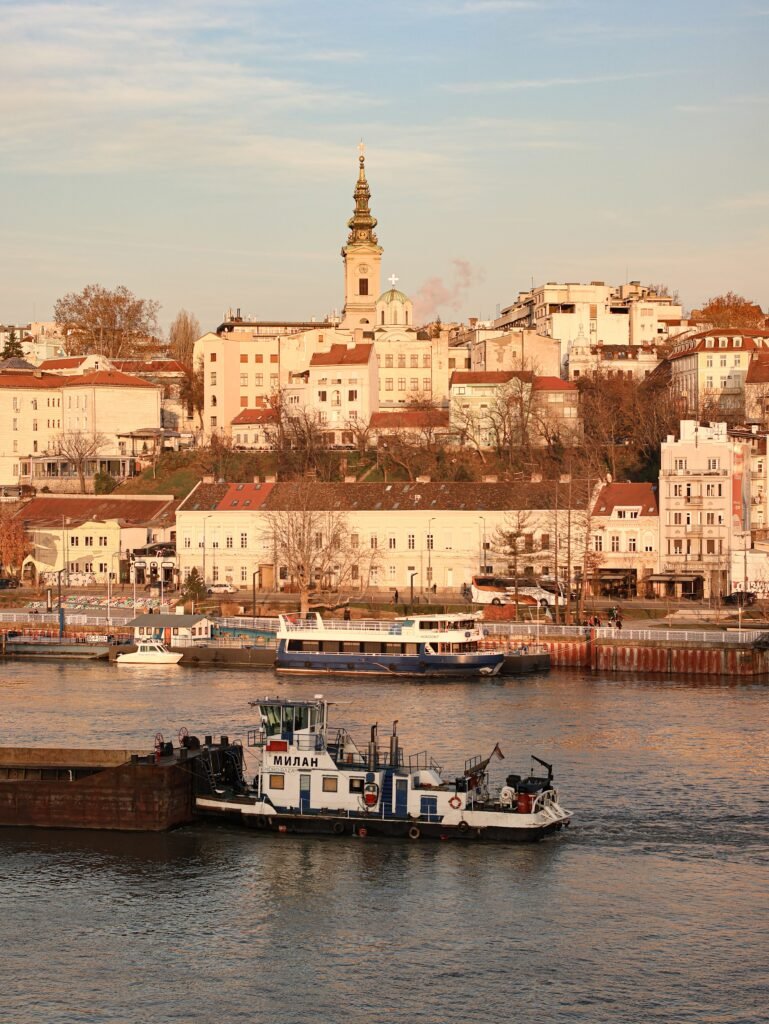
Belgrade: indestructible city rising from its ashes
Belgrade, where the Sava embraces the Danube, a capital is told in whispers – and sometimes shouting. A name that carries a promise Beli — white. Grad — city. The white city. Some attribute this nickname to the limestone of the fortress, dazzling under the Serbian sun; others, to the brilliance of the Danube at daybreak. No matter: Bograd carries with it a promise — that of a city that, despite everything it has been through, continues to shine. And she's been through a lot. A story of destruction and rebirth Belgrade didn't just grow. It was built, razed, reconquered, bombed, burned — and rebuilt, again and again. Even before the arrival of the Slavs in the 4th century BC, the Celts had established Singidunum there. The Romans made it a prosperous military camp. With the fall of Rome, waves of invaders followed one another: Huns, Avars, Byzantines, Bulgarians – each empire saw it as a strategic barrier. In the Middle Ages, the city became the capital of the Kingdom of Serbia under Stefan Lazarević, before the Ottoman shadow extended over the Balkans. The Ottomans captured Belgrade in 1521 and remained there, with some Austrian interruptions, until 1867. Three and a half centuries of minarets and hookah cafés. Then came modern Serbia, two world wars – Belgrade was one of the most bombed cities of the 20th century – Tito's Yugoslavia, the disintegration of the 1990s and the NATO strikes in 1999. Each time, the city got back up and reinvented what it wanted to be. Ten secret places where Belgrade really reveals itself Kalemegdan has dominated the confluence of the two rivers for millennia. Its walls bear the scars of at least forty battles; today, they especially invite contemplation, the gaze lost towards Novi Beograd in the amber light of the evening. Topčider Park , long frequented by princes, retains the elegance of times gone by. Its avenues of century-old trees offer a haven of freshness away from the hustle and bustle. The Avala , a gentle mountain a few kilometers from the capital, is the natural escape for Belgraders — deep forests, quiet trails and a panorama encompassing the entire city. Belgrade Waterfront embodies the city of the 21st century: on the banks of the Sava, the slender Kula Beograd has become a new icon, surrounded by cafes and promenades facing the river. The Temple of Saint Sava , with its dazzling whiteness and cetadon green dome, watches over the city from Vračar Hill. The interior dazzles with its golden mosaics — a place where spiritual grandeur speaks for itself. Princess Ljubica's Konak , a 19th-century mansion a stone's throw from the cathedral, immerses the visitor in the beginnings of independent Serbia – refined salons and sculpted furniture at the crossroads of empires. Tašmajdan Park is based on the memory of ancient quarries. A meeting place for families and students, in the evening it takes on an almost theatrical atmosphere under its soft lights. Knez Mihailova Street , an elegant pedestrian artery, connects modern entertainment with period facades. It is here that the pulse of Belgrade is at its most joyful. The National Museum , facing Republic Square, brings together treasures from antiquity to contemporary art — a journey through the layers of Serbian and European culture. Skadarlija , a cobbled and bohemian alley, is the Belgrade Montmartre. In the evening, violins and laughter mingle in a timeless atmosphere that reveals the popular soul of the city. 3 legendary figures who grew up in Belgrade Marina Abramović , born in 1946 into a family of Yugoslav war heroes, drew discipline and rebellion from Belgrade — two sides of the same coin. Before becoming “the grandmother of performance art,” she walked these streets searching for the limits of her own body. In his resistance we read something profoundly Belgrade: this capacity to endure and be reborn. © Francesco Pierantoni / Flickr — CC BY 2.0 Dragoš Kalajić , painter and philosopher born in 1943, is a more secret figure in the Serbian cultural imagination. His monumental paintings, nourished by symbolism and medieval tradition, reflect a complex reflection on European identity. Controversial, unclassifiable, he embodies this intellectual Belgrade which thinks against the world. Mihailo Petrović Alas , a mathematician born in 1868, is perhaps the city's most internationally unknown son — and one of its most brilliant. A student of Henri Poincaré in Paris, founder of the Serbian mathematical school, he published pioneering work in the theory of differential equations. But the Belgraders nicknamed him Alas — the fisherman — because this man navigated between theorems and the Danube with the same quiet grace. The night and the table in Belgrade The Belgrade night begins on the water. Splavovi — pontoon clubs moored on the Sava — mix the informal and the intense, the music rising while the city lights are reflected in the current. On land, Béton Hala offers a cutting-edge electronic scene in an industrial setting; La Fayette maintains a rare musical requirement; Gradska Kafana Club combines tradition and contemporary nightlife. But the real soul of the night is found in Skadarlija, in the kafane where violins play until dawn and the local wine flows without calculation – no dress code, just candles, the smell of toast and voices singing in unison without realizing it. On the dining side, Radnički na Novom Beogradu keeps the secrets of popular Serbian cuisine with generous portions and honest prices. Miris Zavičaja — “the scent of the native country” — offers careful traditional cuisine that crosses regions and seasons. For the morning burek, the Ruža and Tripković bakeries still pass on their know-how without compromise. And Crna Ovca — the Black Sheep — has made ice cream an art in its own right: unexpected flavors, worked textures, unreasonable generosity. Belgrade can be visited as much with the eyes as with the heart. Indomitable and tender at the same time, this city was never made for rushing — any more than