
The assassination of Zoran Đinđić on the 12th of March 2003 was not only an attack on one man, but also on the vision of a modern, European Serbia, that he was striving to build. This crime symbolises the political and social situation of the time, marked by organised crime, poverty, and exhaustion caused by the wars of the previous decade. However, this period was also characterised by a certain optimism and by the hope of a new beginning after the fall of Slobodan Milošević’s regime, with the introduction of progressive ideas and the reform efforts led by Zoran Đinđić. Sadly, his premature death prevented him from carrying out these reforms fully.
To understand how this assassination was able to take place, it is first necessary to examine the broader political situation at the beginning of the 2000s. This period was marked by strong pressure from the international community, a disastrous economic situation, the presence of criminal groups, corruption within state institutions, the excessive autonomy of the Special Operations Unit (JSO) at the time, and disagreements within the ruling coalition.
Who was Zoran Đinđić ?
Zoran Đinđić was born on 1 August 1952 in Bosanski Šamac, today located in Republika Srpska, Bosnia and Herzegovina. He later moved to Belgrade, where he completed his secondary education at the Ninth Belgrade Gymnasium. After graduating, Đinđić began studying philosophy at the University of Belgrade. It was during this period that he began his informal political career through student activism, becoming the leader of the Student Union at the Faculty of Philosophy. During this time, he openly criticised the ruling regime, advocating democracy and freedom of expression while denouncing authoritarianism. In 1974, he took part in a student meeting in Ljubljana and contributed to the drafting of the “Resolution of the Student Unions of the Faculties of Philosophy of Belgrade, Ljubljana and Zagreb”. This act led to his arrest and a one-year prison sentence, which he avoided thanks to influential family connections. Faced with conflicts with the socialist regime of the time, Đinđić left for Germany, where he continued his studies at the University of Konstanz. Under the supervision of the renowned philosopher Jürgen Habermas, he defended a thesis entitled “Problems in the Foundation of Critical Social Theory”.
In 1989, Đinđić returned to Yugoslavia, where he taught philosophy at the University of Novi Sad and worked as a senior researcher at the Centre for Philosophy and Social Theory in Belgrade. In 1990, he co-founded the Democratic Party (DS) with like-minded colleagues, first becoming president of its executive committee and then, in 1994, president of the party, succeeding Dragoljub Mićunović. Đinđić was elected as a member of the National Assembly of the Republic of Serbia, where he served during three multi-party parliamentary terms, as well as in the Council of Republics of the Federal Assembly of the Federal Republic of Yugoslavia.
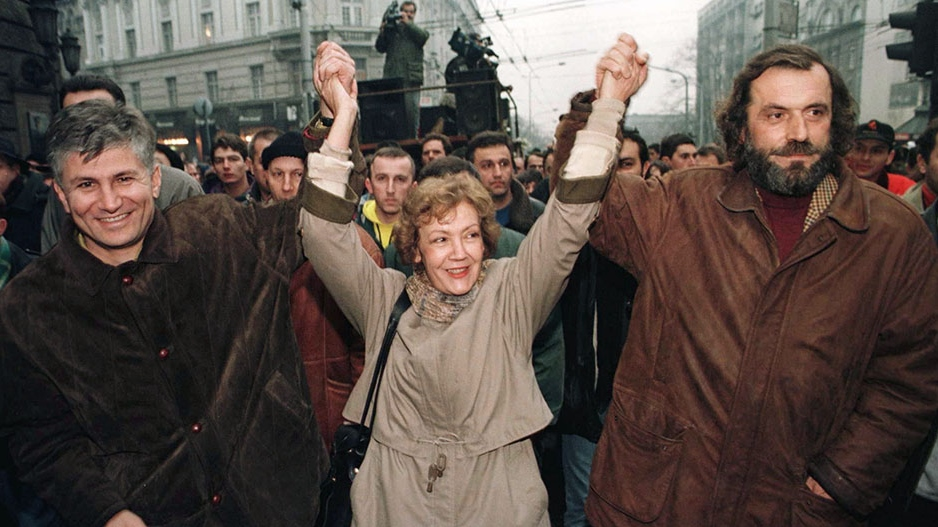
In November 1996, despite his reservations, the Democratic Party took part in the local elections as part of the “Zajedno” coalition (“Together”), alongside Vuk Drašković’s Serbian Renewal Movement and Vesna Pešić’s Civic Alliance of Serbia. This coalition won the elections in Belgrade, Niš, and Novi Sad, but Slobodan Milošević refused to recognise the results, triggering large-scale demonstrations that eventually forced him to give in. Đinđić then became president of the Belgrade City Assembly, but he was removed from office after only seven months. Shortly afterwards, the “Zajedno” coalition dissolved due to strategic disagreements.
At this time, Đinđić became an increasingly threatening figure to Milošević’s regime. Fearing for his life, he temporarily left the country in 1999 after the assassination of journalist Slavko Ćuruvija. He returned later that same year and, despite the regime’s attempts to sideline him, led the Democratic Opposition of Serbia (DOS) coalition, made up of 18 parties, to victory in the 2000 parliamentary elections.
The main aim of this coalition was to overthrow Milošević. It won 64.09% of the vote, while Vojislav Koštunica won the presidency. Milošević’s refusal to recognise his defeat triggered the famous demonstrations of 5 October, which led to his downfall. On 25 January 2001, Zoran Đinđić became Prime Minister of Serbia, while Vojislav Koštunica held the position of President of the Federal Republic of Yugoslavia.
The 5th of October 2000
At that moment, the DOS was aware of its popular support, but the main obstacle lay in the state institutions that had remained loyal to Milošević, particularly the Special Operations Unit (JSO), led by Milorad Ulemek Legija and also known as the “Red Berets”. Operating under State Security, this unit was used by Milošević for “dirty work”, such as the assassination of political opponents, including the kidnapping and murder of former president Ivan Stambolić, an attempted assassination of Vuk Drašković on the Ibar Highway, the murder of critical journalist Slavko Ćuruvija, the kidnapping of businessman Miroslav Mišković, and many other crimes.
Aware of this danger, the DOS leadership feared that the JSO might be ordered to open fire on the demonstrators. To prevent this, Zoran Đinđić reached an agreement with Legija, who, seeing that Milošević’s end was imminent, agreed not to fire on the protesters, thereby signalling his tacit acceptance of the new government. Under the pressure of these mass demonstrations, Slobodan Milošević recognised his defeat the following day in a televised address. On 7 October, Vojislav Koštunica was sworn in as president, and shortly afterwards a new administration was formed under Zoran Đinđić, who took office on 25 January 2001.
After the presidential elections of the Federal Republic of Yugoslavia, held on 24 September 2000, the outgoing president, Slobodan Jovanović, declared that the main opposition candidate, Vojislav Koštunica, leader of the Democratic Opposition of Serbia (DOS), had received only 49% of the vote, making a second round necessary. In response, the DOS called on citizens to gather on 5 October in front of the Federal Assembly to protest against the “major electoral fraud” orchestrated by the Federal Electoral Commission on the orders of Slobodan Milošević, claiming that Koštunica had in fact received 50.24% of the vote.
The Zemun Clan
The Zemun Clan was one of the most powerful criminal organisations in the Balkans, and even beyond. Its peak came between 1999 and 2003, a period during which it carried out numerous criminal activities, including kidnappings, assassinations, car thefts, and drug trafficking. The founders of the clan, Dušan Spasojević Šiptar and Mile Luković Kum, initially collaborated with the Surčin Clan, led by Ljubiša Buha Čume. However, they soon became independent and expanded their activities, moving from simple car thefts and the trafficking of small quantities of drugs to far more serious crimes.
After the fall of Slobodan Milošević, the Zemun Clan intensified its collaboration with Milorad Ulemek Legija and his Red Berets unit, the JSO, committing various crimes together. What made this criminal organisation particularly powerful was its close links with state institutions and its ability to place loyal individuals within them, especially within State Security, later renamed the BIA. Thanks to these connections, the clan was able to evade justice, access crucial information, and prevent its activities from being uncovered. This network of influence, which tied the Zemun Clan to state institutions, made it almost impossible to eradicate organised crime, which had become an integral part of the politics of that period.
Zoran Đinđić‘s politics
Zoran Đinđić’s main objective upon coming to power was to launch a complete reconstruction of a country that had been deeply devastated over the previous decade. Economic sanctions and bombings had completely ruined the Serbian economy, while the wars had caused a massive influx of refugees from Croatia, Bosnia and Herzegovina, and Kosovo.
At the same time, corruption and organised crime permeated every aspect of society. Đinđić also had to address delicate issues such as relations with Montenegro, escalating tensions in Kosovo, and the handling of war criminals.
At the time, the Federal Republic of Yugoslavia (FRY) was isolated from the international community: it was neither a member of the United Nations nor involved in any form of multilateral cooperation. This situation was worsened by conflicts and disagreements within the ruling coalition, particularly between Đinđić and Vojislav Koštunica, who had different approaches to solving these problems.
What characterised Đinđić was his progressive thinking, remarkable ambition, and insistence on efficiency in all areas. Both his close collaborators and his opponents recognised his fast pace of work and his sometimes impulsive decision-making, traits that were often the subject of criticism.
Cooperation with the European Union and the Kosovo and Metohija question
One of the main features of Zoran Đinđić’s politics was his pro-European orientation. He considered accession to the European Union essential for Serbia’s progress. Đinđić advocated the establishment of European standards in all areas of society, including justice, the economy, and politics. He also believed that economic aid and cooperation with the West were crucial for rebuilding a devastated country which, because of the irresponsible policies of previous governments, struggled even to provide electricity to its population.
For this reason, he began negotiations for Serbia’s integration into the EU. However, this initiative divided public opinion, as part of the population remained reluctant to cooperate closely with the countries involved in the bombing of the FRY in 1999.
In addition to European integration, Đinđić launched a diplomatic campaign in 2003 to resolve the issue of Kosovo and Metohija. As part of this effort, he wrote to the President of the United States, George W. Bush, the Russian President, Vladimir Putin, and the United Nations Security Council. On the day of his assassination, he was also scheduled to meet the Swedish Minister for Foreign Affairs, Anna Lindh, a meeting he would never attend. Due to his premature death, Đinđić never had the opportunity to fully devote himself to resolving the status of Kosovo and Metohija.
Extradition of Slobodan Milošević to The Hague Tribunal and the Rebellion of the Specialised Operations Unit (JSO)
Less than a year after being removed from power, Slobodan Milošević was arrested on 1 April 2001 at Villa Mir and transferred to the Central Prison, accused of abuse of power and corruption. What led Milošević to surrender was Zoran Đinđić’s promise to respect three conditions: not to extradite him to The Hague, not to touch his family, and not to confiscate his property. However, Đinđić did not keep any of these promises.
At that time, an arrest warrant for Milošević had been issued by the International Criminal Tribunal for the former Yugoslavia (ICTY), but extradition had not yet been demanded. This changed when the United States asked Serbia to hand Milošević over, threatening to cut off funding from the IMF, the World Bank, and the European Union, which was essential for Serbia’s severely struggling economy. Under this international pressure, Đinđić decided that it was necessary to transfer Milošević to The Hague.
This decision provoked strong opposition, particularly from Vojislav Koštunica, who publicly denounced the extradition as a violation of Serbia’s sovereignty and constitution. Koštunica argued that Milošević should be tried by Serbian institutions and criticised the tribunal as being biased against Serbs. Serbian society, deeply divided, was also sceptical of an international tribunal that had mostly prosecuted Serbs. To move the extradition forward, Đinđić called an emergency government meeting. While Milošević’s lawyers filed a complaint with the Constitutional Court, which requested two weeks to examine the case, Đinđić ignored these proceedings and ordered the extradition. On 28 June 2001, Vidovdan, Milošević was transferred by helicopter to Tuzla and then to The Hague, where he died in 2006 before the end of his trial.
As expected, this decision triggered protests and unrest among the population, particularly among veterans of the wars of the 1990s. Koštunica continued to openly criticise the decision as unconstitutional. In response, Đinđić argued that the Hague Tribunal was an international institution of the United Nations and not a foreign court, and that his action was in accordance with the constitution of the FRY.
Nevertheless, this remained one of Đinđić’s most controversial decisions, deeply dividing public opinion and reducing his popularity.
Rebellion of the Special Operations Unit (JSO) in November 2001
In November 2001, the rebellion of the Special Operations Unit (JSO), also known as the “Red Berets”, marked one of the most serious political and security crises of the post-Milošević period. Officially, this mutiny was a reaction to the extradition of several indictees to the International Criminal Tribunal for the former Yugoslavia (ICTY), including the brothers Predrag and Nenad Banović. However, it is widely accepted that the real motivation lay in the fear among JSO members that they themselves might be extradited to The Hague for their crimes.
Under the leadership of Milorad Ulemek “Legija”, armed and uniformed members of the JSO blocked the motorway near Vrbas, as well as the area around the Sava Centre in Belgrade. This show of force was a disturbing demonstration of the power that this paramilitary unit, officially subordinated to the state, exercised over the government.
The mutiny also reflected internal political tensions. Vojislav Koštunica, President of the Federal Republic of Yugoslavia, openly supported the rebellion, claiming that it did not endanger national security. He was joined by opposition parties such as the Socialist Party of Serbia (SPS) and the Serbian Radical Party (SRS). This support further divided Zoran Đinđić’s government and illustrated the conflict between his pro-Western reforms and an opposition rooted in nationalism and the structures inherited from the Milošević era.
Faced with the threat posed by the JSO, and with the fact that the police could not prevent a possible assault on the government, Đinđić was forced to enter into negotiations. The compromise imposed by the JSO was humiliating for his government: the Minister of the Interior, Dušan Mihajlović, dismissed Goran Petrović, head of the State Security Service, and his deputy Zoran Mijatović, two men committed to the fight against organised crime.
Although the mutiny ended on 17 November 2001, it revealed the depth of the links between criminal structures and certain state institutions. It also highlighted the challenges Đinđić faced in establishing the rule of law, strengthening democratic institutions, and dismantling criminal networks protected by influential political figures.
Fight against organised crime
Despite the change in power, a large number of individuals still working within public institutions remained loyal to the former president or collaborated with criminal organisations. Đinđić was aware that, without reforming public institutions and fighting corruption and organised crime, Serbia would not be able to progress. To address this problem, he launched several initiatives, among which the introduction of the law against organised crime was probably the most significant. This law included the creation of a special section within the District Court of Belgrade, today known as the Special Department of the Higher Court, commonly referred to as the Special Court, whose task was to try members of criminal groups. In addition, the law provided for special investigative methods, accelerated procedures, and witness protection. The witness protection clause, concerning cooperating witnesses, was particularly important at that time because Ljubiša Buha Čume, the former leader of the Surčin Clan, was under state protection with the intention of testifying. Buha had decided to withdraw from crime and testify about the activities of his former accomplices from the Zemun Clan in order to assist the investigation. For this reason, he was the main target of the Zemun Clan and had to remain under constant state protection. The application of the organised crime law was therefore especially urgent, as the authorities feared that Buha might be killed before obtaining the status of cooperating witness, which would have compromised his ability to testify, a crucial element of the investigation.
Another action launched under Đinđić’s mandate was the dismissal of all individuals linked to Milošević and criminal groups, in order to eradicate corruption and reduce the possibility of sabotage against the new regime or of a coup d’état. This went hand in hand with the establishment of new EU-inspired standards of professionalism in the work of the police and the judiciary. Đinđić was in an “open war” with the Zemun Clan and, therefore, with Legija and his JSO. He clearly showed that he was prepared to confront the dangers involved in fighting powerful criminal structures, and he publicly emphasised this necessity, which further angered the members of the clan and made Zoran Đinđić their target.
Assassination of the Prime Minister
Prime Minister Zoran Đinđić was killed on 12 March 2003, at around 12:30 p.m., at the entrance to the government building in Belgrade, after he had stepped out of his vehicle while moving with the aid of crutches. The fatal bullet, which struck him in the heart, was fired from a sniper rifle from the window of a building on Admiral Geprata Street. The Prime Minister was immediately taken to the Emergency Centre, where he was pronounced dead an hour later, at 1:30 p.m. In addition to the bullet that killed the Prime Minister, another bullet struck Milan Veruović, the head of his security detail, in the stomach.
The assassin was Zvezdan Jovanović, a member of the JSO, who fired on the orders of Milorad Ulemek Legija. At the time of the assassination, members of the Zemun Clan were present at the scene: Aleksandar Simović, Ninoslav Konstantinović, Sretko Kalinić, Milan Jurišić, Saša Pejaković, Dušan Spasojević, Dušan Krsmanović, and Mile Luković. The driver was Vladimir Milisavljević, while Miloš Simović was responsible for passing on information about the Prime Minister’s movements, which he received from Dušan Krsmanović, a member of the Security Information Agency (BIA). Testimonies given after the assassination revealed that this was not the first attempt to kill the Prime Minister. Three failed attempts had preceded the assassination and are now publicly known: the attempts near Bubanj Potok, near the Belgrade Arena, and near the Federal Assembly. The assassination of the Prime Minister had been planned for months and, according to Sretko Kalinić, was devised by Luka Bojović on Legija’s orders. The weapon used was a Heckler & Koch sniper rifle, and it was later proven that the rifle belonged to the JSO and had been buried on a construction site after the assassination. All those involved in the assassination immediately hid in apartments that had been rented in advance, waiting for the situation to calm down.
However, to their great surprise, the decision was made to introduce a state of emergency, and a police operation named “Sablja” (“Sabre”) was launched. The main motive behind the assassination of Zoran Đinđić was his ambitious and firm decision to eradicate organised crime in the country and its links with government institutions. This clearly angered the members of the Zemun Clan, and above all Milorad Ulemek. They believed that by assassinating the Prime Minister, they would succeed in removing his collaborators and bringing to power someone who would agree to cooperate with them, as Slobodan Milošević had done, allowing them to continue their criminal activities without obstruction. In addition, another motive for the assassination was the dissatisfaction of those who had fought during the 1990s and strongly condemned the Prime Minister for cooperating with the International Criminal Tribunal for the former Yugoslavia and for extraditing their wartime comrades. According to Zvezdan Jovanović’s testimony, this was the main reason why he agreed to shoot Đinđić, as he was considered a skilled marksman within the unit.
At the time of the assassination, responsibility for the physical protection of high-ranking figures, including the Prime Minister, belonged to the Ministry of the Interior, while the task of the Security Information Agency (BIA) was to collect information that could be relevant to security. Accordingly, the BIA should have been informed of the planned assassination of Zoran Đinđić and should have passed this information on to the Ministry of the Interior. Officially, the BIA had no information about it, apart from certain individuals who were collaborating with the perpetrators of the assassination. The reason for this failure was attributed to the numerous reforms and organisational changes initiated by Đinđić, which had created difficulties in coordination between the different security sectors and, consequently, poor circulation of crucial information. The BIA had only existed for a few months at the time of the assassination, which clearly contributed to the agency’s ineffectiveness. Zoran Đinđić was buried with the highest state honours in the Alley of Distinguished Citizens at Belgrade Cemetery on 15 March 2003. The funeral service was held at the Church of Saint Sava, from where the procession departed, followed by around 500,000 people. After his death, it was estimated that Đinđić’s popularity rose from around 30% to approximately 60%. Despite the many controversies and the turbulent period during which he served as Prime Minister, he remained in collective memory for his determination, ambition, and belief in a better and modern Serbia.
Operation “Sablja” – Who is responsible ?
Immediately after the assassination of the Prime Minister, a state of emergency was declared in the country on the same day, officially marking the beginning of the police operation to search for and arrest those suspected of having taken part in the assassination of Đinđić. This operation was named “Sablja” (“Sabre”). As soon as the Prime Minister’s death was announced, his role was taken over by Deputy Prime Minister Nebojša Čović, who, together with the President of the National Assembly of Serbia, Nataša Matić, made the decision to declare a state of emergency on 12 March 2003. The purpose of the state of emergency was to support the police operation by granting the police and judicial authorities expanded powers to collect evidence, carry out searches, and arrest suspects without following the usual procedures that could have slowed the process. This decision was also intended to maintain the stability and security of the state by preventing possible further attacks or rebellions in an already destabilised country.
It was also necessary to appoint a new Prime Minister, and according to an agreement within the Democratic Party, this role was given to the party’s vice-president, Zoran Živković, on 18 March. In addition to him, many other individuals were appointed to new positions, as a large number of people within government institutions were suspected of collaborating with the perpetrators of the assassination. Among them, the commander of the Gendarmerie, Nebojša Pavković, the director of the Belgrade Police, Dobrivoje Kadić, the assistant to the Minister of the Interior, Miroslav Mitić, and many others were dismissed from their positions. In addition to mass arrests and personnel changes, one of the consequences of the operation was also the disbanding of the Special Operations Unit. As part of the mass detentions following the assassination, hundreds of suspects were questioned and arrested every day, and large quantities of illegal weapons, stolen cars, and drugs were discovered. The operation also uncovered and clarified many other crimes from previous years linked to the Zemun Clan, for which its members were later tried.
As part of this operation, which officially lasted until 22 April 2003, 11,665 people were detained, dozens of whom were arrested and convicted of various crimes. After three and a half years, on 23 May 2007, the Special Court in Belgrade sentenced 12 members of the Zemun Clan to a total of 378 years in prison for the murder of the Prime Minister, with Milorad Ulemek and Zvezdan Jovanović each receiving the maximum sentence of 40 years. The assassination of the Prime Minister was not the only subject of the trials; members of the Zemun Clan received three collective sentences: one for the murder of Zoran Đinđić, another for 17 murders, three kidnappings, and two terrorist attacks, and a third for three kidnappings and one case of extortion. Five members of the clan were convicted under all three sentences.
Zoran Đinđić on the failed assassination attempt against him:
(Politika, 21 February 2003. And Glas javnosti, 24 February 2003.)
“ If anyone thinks that they can stop the enforcement of the law by eliminating me, they are seriously mistaken, because I am not system. The system will continue to function, and no one will be granted amnesty for their crimes by eliminating one or two state officials.”