
Imagine an artist whose brushstrokes succeeded in bringing history back to life, whose paintings became symbols of national pride, and whose art crossed borders and eras. Such was Paja Jovanović — a painter who brought Serbian culture and tradition onto the European artistic stage, leaving behind masterpieces that continue to inspire us today. His works are not merely paintings, but visual narratives that speak of heroes, customs, and the spirit of the age. Paja Jovanović was not only an artist — he was the chronicler of a people, a visionary, and an ambassador of beauty.
Childhood and Education
Paja Jovanović was born on 16 June 1859 in Vršac, into a family of craftsmen. His first contact with art came from the atmosphere of his home, but from a very young age he showed a talent for drawing. His father, Stevan Jovanović, was a well-known photographer in Vršac. This allowed him to come into contact with photography, and more generally with art, from childhood. His mother was named Ernestina, née Doet, and was of French origin. Paja had five brothers and one sister, and was always surrounded by the warmth of a large family. From an early age, he showed an interest in art, especially thanks to his father, since working in photography at that time required not only technical knowledge, but also a skilled hand for retouching images. In Vršac, he also had the opportunity to be around great painters such as Arsenije Arsa Todorović, Pavel Đurković, and Jovan Popović. To support his interest in art, his father sent him to Belgrade, where Paja had the opportunity to develop in a cultural and intellectual environment. This is how Paja Jovanović began to draw, at first secretly, copying religious images and spending hours in an empty church, which he considered his first teacher.
However, when the parish of Vršac decided to order new bells for the cathedral and drawings of saints were needed — copies of the icons from the church in Vršac, from which reliefs would later be made on the bells in Vienna — his talent was discovered. At the age of fourteen, Jovanović received his first commission and, thanks to much praise, gained a kind of passport to Vienna and the possibility of entering the Academy of Fine Arts.
At a very young age, he showed exceptional ability in the visual arts, and his parents therefore decided to enrol him at the School of Arts and Crafts in Belgrade. There, he received a basic artistic education, learning to draw, paint, and master fundamental techniques. In April 1877, he enrolled in a general painting course at the Academy of Fine Arts in Vienna, and by October of the same year he had become a regular student at the academy, studying under the highly respected professor and skilled teacher Christian Griepenkerl (1839–1916). He completed his regular painting studies in three years, on 21 July 1880, but continued his training under the same professor in a special course devoted to historical painting.
At the same time, he further developed his skills in the master class of Professor Leopold Karl Müller (1834–1892), a painter who was highly sought after and praised at the time for his historical and genre painting, especially his works with Oriental themes, particularly scenes from Egypt. Jovanović soon became his best student.
Although he was influenced by academicism, Paja Jovanović’s training in Vienna also exposed him to other artistic movements, such as Romanticism and Realism, which would later influence his work. In addition, his time in Vienna allowed him to develop a deep understanding of art and to master painting techniques, particularly in the context of historical compositions and portraiture.
Voyages
Paja travelled widely around the world, observing landscapes, peoples, and cultures that he later transferred into his paintings. His professor at the Academy of Fine Arts in Vienna advised him to visit his region of origin, where he could paint a large number of Oriental motifs. Paja therefore travelled through Serbia, Montenegro, Bosnia, and Albania, painting scenes of everyday life. Enriched by these impressions, he went on to paint many genre scenes, including The Wounded Montenegrin, The Duel, The Epic Singer, The Bride’s Adornment, In Ambush, The Albanian, The Arnaut with a Chibouk, The Traitor, Blood Feud, and The Cockfight. These works attracted attention in nineteenth-century Europe, at a time when Europe was highly interested in events in the Balkans.
His first recognition came in 1882, during his studies in Vienna, for his painting The Wounded Montenegrin. This painting was exhibited at the Academy’s annual exhibition and won him first prize as well as an imperial scholarship.
The following year, he signed a ten-year contract with the famous gallery owner Valis for the French Gallery in London and, at the end of 1883, moved there to live and work.
His works sold very well, which freed him completely from financial worries and allowed him to travel frequently to distant and expensive destinations, including North Africa, Morocco and Egypt, as well as Greece, Turkey, Italy, and Spain. With his friend, the Russian painter Franz Roubaud, he spent six months in the Caucasus.
Shortly afterwards, he left London and moved to Munich, then to Paris, before returning to Vienna.


Relations with France
Paja Jovanović maintained a deep and meaningful relationship with France throughout his artistic development and career. After his studies in Vienna, where he acquired his basic artistic skills, Paja travelled to Paris, then the artistic centre of the world, to further refine his craft. There, he was influenced by French academicism and realism, which helped shape his work. In Paris, he studied the works of great masters such as Eugène Delacroix and Gustave Courbet, who helped him develop his technique and his approach to historical themes.
Paja Jovanović participated in the Paris Universal Exhibition of 1889, which allowed him to present his works within prestigious French artistic circles and gain international recognition. His presence at this exhibition was significant, as it showed that he had become an important figure in the European art world. Although he remained deeply rooted in Serbian tradition, Jovanović adapted his art to European standards, allowing his works to be recognised in France as well.
Jovanović remained faithful to Serbian themes, particularly those inspired by history and folk traditions, but technically he was strongly influenced by French art. He was respected among French artists, and his works were exhibited in prestigious salons and exhibitions. In France, he enjoyed a strong reputation, and his work was frequently praised for its academic precision and realistic depiction of figures and scenes.
Although many Serbian artists of this period exhibited in the pavilion of the Kingdom of Serbia, Paja Jovanović participated in the Rome Universal Exhibition in 1911 but chose to exhibit in the pavilion of the Austro-Hungarian Empire, which testified to his international importance and his place within artistic circles.
Thus, through his time in France and his contacts with French artists, Paja Jovanović became a bridge between Serbian and European art, combining tradition with modern artistic movements.
Work
Paja mainly painted portraits and created numerous historical compositions. Among his most famous historical compositions are:

This is probably Paja’s best-known historical work. It depicts the migration of the Serbs under Patriarch Arsenije III Čarnojević at the end of the seventeenth century. The painting is dramatic and symbolic, placing emphasis on the patriarch and the people leaving their homeland.

Inspired by a folk poem, this work depicts a scene after the Battle of Kosovo in 1389, in which a young woman helps a wounded soldier. The scene is filled with melancholy and heroism.

This painting shows Emperor Dušan the Mighty at the moment when he proclaims his law code, one of the most important legal documents of the Serbian Middle Ages.

Elle représente Miloš Obrenović au moment du déclenchement du Deuxième soulèvement serbe en 1815. Le tableau est un symbole de la lutte pour la liberté et l’indépendance.

Bien qu’il ne s’agisse pas d’une scène historique classique, ce tableau est souvent associé à la tradition et à la vie du peuple serbe, offrant un aperçu des coutumes de l’époque.
Through his art, Paja Jovanović succeeded in documenting important moments in Serbian history while interpreting them in a way that evoked emotion and a sense of national pride.
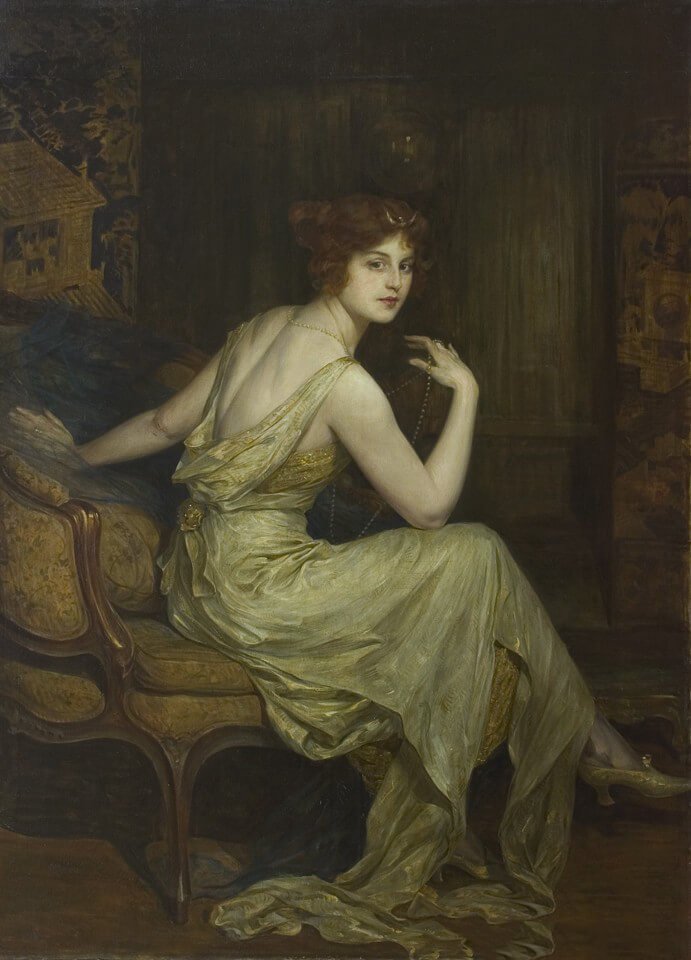
In addition to his historical compositions, Paja Jovanović was one of the most respected portrait painters of his time. His portraits are distinguished by exceptional technique, realism, and an ability to reveal the psychological characteristics of the people he depicted. Paja painted portraits of nobles, rulers, artists, and ordinary citizens, making his work varied and widely recognisable.
Caracteristics of the portraits of Paja Jovanović
Realism and attention to detail: Each portrait stands out for its precision, from anatomical proportions to the textures of clothing and ornaments.
Psychological depth: His works reveal the inner world of the figures he portrayed, whether through facial expression, posture, or the overall atmosphere of the image.
Combination of academic style and personal interpretation: Paja often combined the strict technique of the European academic school with elements of local tradition and the spirit of the time.
Famous Portraits of Paja Jovanović

This is one of his most famous portraits, showing the Queen of Serbia with dignity and elegance.

The scientist is depicted in a solemn pose, highlighting his greatness and importance in the world of science.

One of Paja Jovanović’s most famous portraits, this work emphasises the mystical and melancholic nature of the poet.

This portrait is an example of Paja’s ability to represent luxury and social status through the careful treatment of textures and decoration.
Self-Portraits
Paja created several self-portraits at different periods of his life, showing his artistic development and his introspective gaze.
Portrait of Baron Gautsch
This portrait of the Austrian statesman in his official attire reflects the prestige and authority of the figure.
Paja’s work in the field of portraiture was particularly appreciated in Europe, where his portraits were often considered synonymous with elegance and artistic perfection. These works form an important part of his oeuvre and confirm his status as one of the greatest artists of his time.
Wife Muni
Paja Jovanović had a harmonious and inspiring marriage with his wife, Hermina Dauber, known as Muni. They met in Vienna, where Muni worked as an artist’s model, and she soon became his muse and life companion. They married in 1917 and remained together until her death in 1946.
Muni was a key figure in Paja’s life, offering him support and taking part in his creative process. She often posed for his portraits, and her image radiates elegance and love in many of the artist’s works. Their home in Vienna was a meeting place for artists and intellectuals, where Muni played an important role in promoting Paja’s work.
Her presence was not only a source of emotional support, but also of practical help during difficult periods. Through her image in his paintings and the memories of their shared life, Muni remains an inseparable part of Paja’s artistic legacy.
His work remained a symbol of mastery, dedication, and love for art, and the final years of his life were marked by peace, but also by sadness caused by the loss of his beloved wife and companion.
The lost painting, FUROR TEUTONICUS

Although The Battle of the Teutoburg Forest was one of Paja’s most ambitious works, the painting disappeared over time. It is believed to have been destroyed during the First or Second World War, when many works of art were damaged as a result of wartime destruction. There is little information about where it was located after its creation, and today only preserved writings and sketches bear witness to this work.
The disappearance of this painting represents a significant loss for the art world, as its preservation would have shed further light on Paja’s virtuosity and his contribution to historical painting.
The final years of Paja Jovanović
The final years of Paja Jovanović’s life passed in silence and isolation, far from artistic circles and the public eye. After the death of his wife Muni in 1946, Paja was deeply affected emotionally and spent most of his time in solitude. He lived in Vienna, where he had spent much of his life, but rarely appeared in society.
Although he was an extremely respected and recognised artist, in his later years he was no longer actively creating new works. His energy and creativity, which had guided him throughout his life, had considerably diminished after Muni’s death. Paja died on 30 November 1957 in Vienna, at the age of 98, leaving behind a rich artistic legacy that remains of exceptional value to Serbian and world art.
Paja Jovanović left an indelible mark on Serbian and world art as one of the most important painters of his time. His works, whether historical compositions, portraits, or scenes of everyday life, are characterised by exceptional technique, attention to detail, and the ability to bring the spirit of the age to life.
Through works such as The Migration of the Serbs, The Takovo Uprising, and numerous portraits, Paja became a chronicler of national history and culture, while also gaining recognition beyond Serbia’s borders. His passion for art, his commitment to realism, and his unique bond with his wife Muni shaped both his work and his life.
Although the final years of his life were marked by isolation and sadness, Paja Jovanović’s legacy remains alive through his paintings, which bear witness to artistic perfection and enduring inspiration. Paja Jovanović will forever remain a symbol of Serbian artistic tradition and its ambassador on the European stage.
In writing this article, I relied on sources such as Wikipedia, the website of the National Museum of Serbia, the website of the Gallery of Matica Srpska, and other articles dedicated to Paja Jovanović.