cuture eng

cuture eng, Non classé

A Review of the Poetry Collection by Simona Dmitrovic

On the occasion of the publication of Simona Dmitrović’s poetry collection “Osim šumskog požara” (“Except for the Forest Fire”), jointly published by the publishing houses Slavitid and PLAN B, Zacharie Zaoui, holder of a Master’s degree (MEGEN) from the Sorbonne, has written a review of this work. We invite you to discover it below.

cuture eng, Non classé

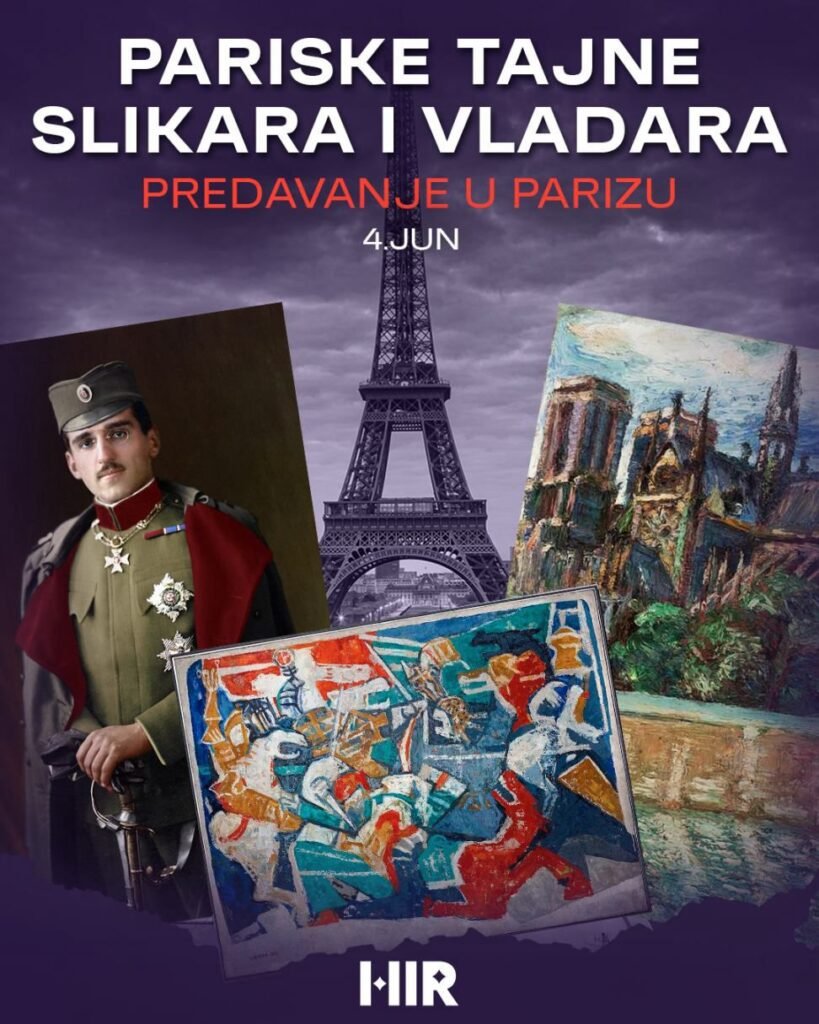
The Parisian Secrets of Serbian Rulers and Painters

Imagine this: you are standing in a Parisian studio, surrounded by canvases that are yet to become part of the history of Serbian art. Or you are sitting at the very table where Serbian rulers once negotiated the fate of a small Balkan state, at a moment when Europe itself was changing its face. This is not a tourist story about Paris. This is a story about what Paris does to a person who approaches it with an open heart — and closed eyes. A ruler who, in France, encountered European ideas of freedom and modern society, while another built diplomatic ties with Paris at a time when Europe itself was changing its face. We will also speak of a ruler who did not love power, but rather the luxury of Paris and its artistic scene. At the same time, in Parisian studios and galleries, another kind of history is being written. An artist who discovers modern art and brings a new energy to Serbian painting. A painter who finds inspiration in Montparnasse and creates works under the influence of the Parisian avant-garde. There is also the enigmatic young collector who, in Paris, works alongside some of the most important names in modern art and builds one of the most fascinating collections of his time. And, of course, the most renowned Serbian painter, who understood how Paris perceives elegance, prestige, and the image of society. The lecture will be held in collaboration with Kulturni HIR on 4 June in Paris.   This is not a lecture.This is an encounter with stories that have waited to be told. Резервишите своје место

cuture eng, Non classé

Eurovision 2025 – Serbia Shines, Even Without Reaching the Final!

Stefan Zdravković, known as Princ od Vranja (Prince of Vranje), is a Serbian singer born in 1993 in Vranje. He has lived in Belgrade since childhood, and in addition to singing, he also plays the guitar and drums. Before fully dedicating himself to music, he was a Serbian karate champion and vice-champion, and even a member of the national team. He began engaging with music at the age of 15, forming a band called Šesta žica (Sixth String) with friends from high school. At the same time, he studied philology at the University of Belgrade, specializing in Scandinavian languages and literature, particularly Norwegian. Since 2016, he has been the lead singer of the band Sizip. In 2020, he played the title role in the musical Jesus Christ Superstar, produced by the Cultural Center of the Student City of the University of Belgrade. He has also participated in numerous music festivals, including Slavianski Bazaar in Belarus, as well as various events in Bulgaria, Kazakhstan, Lithuania, Italy, and Spain. In 2021, he competed in The Voice of Bulgaria, where he impressed the judges but was eliminated before the final. Еurovision 2025 – Serbia Shines, Even Without Reaching the Final This year, Princ od Vranja touched the hearts of Serbs with his song “Mila,” which won the competition Pesma za Evroviziju 2025. Unfortunately, Serbia did not qualify from the semi-final—marking the first time since 2017 that it failed to reach the final. And yet… Serbia had not had the final say yet! Victory came from a different angle: Teya (Teodora Špirić), an Austrian artist of Serbian descent, was one of the co-writers of the song “Wasted Love,” which brought JJ and Austria the Eurovision 2025 trophy. Between the emotions on stage and triumph behind the scenes, Serbia left a real mark this year. No final—but pride intact. Sources:  https://fr.wikipedia.org/wiki/Princ_od_Vranje https://n1info.rs/magazin/showbiz/zbog-cega-je-glasanje-na-ovogodisnjoj-evroviziji-bilo-zanimljivo/ https://www.youtube.com/watch?v=eoSCoV9s2ak https://www.youtube.com/watch?v=7h8yw_9bCV8&list=RDEMleViyZ7nXxvsowEeNoHrMA&start_radio=1 https://www.youtube.com/watch?v=18BCbtvDcag

cuture eng, Geopolitics eng, Géopolitique, historical archives

Identity: A False Concept or Reality?

From Renan to Kosovo: a reflection on what unites us Carried by the wave of Europe’s migration-shaped electoral politics, the question of identity has imposed itself across all political debates in Europe. This concept, often used imprecisely, provokes significant controversy, as it has never been clearly defined. During the First Congress of Serbian Youth, organized in Vienna on 7 June 2025, while discussions among participants had only just begun with the aim of defining a strategy for the development of Serbian diaspora organizations, the debate quickly shifted toward a reflection on what it actually means to be Serbian. Very different ideas immediately emerged, revealing how difficult it is to define identity. This shift in the discussion toward a question that is at once broad and unresolved highlights a deeper issue: can collective identity still be clearly and commonly defined? And if not, what is the point of speaking about it at all? Identity remains an unresolved question. Yet, as with “woke” ideology, its use in public discourse was supposed to ensure a clear definition. One might therefore assume that the very lack of consensus around the definition of identity explains the differences in how people understand what it means to belong to a nation. The truth is that agreement on such a definition is impossible: the Congress itself could not resolve a debate that has lasted for centuries. Identity is defined as “the character of that which, under different names or forms, constitutes one and the same reality,” according to CNRTL. It is therefore closely linked to the concept of the nation, which is also at the heart of political debate. In this sense, it might be more precise to speak of national identity in order to avoid confusion with individual identity. The question of the nation has long been central to profound philosophical reflections, which help us understand that the debate held at the Vienna Congress, although legitimate, is ultimately infinite in scope. And what is infinite is abstract and beyond our rational grasp: the debate therefore appears futile and unnecessary. The very idea of the nation has divided European societies, sometimes even neighbouring ones. Thus, after the fall of Prussia under Napoleon’s control of the territory, Fichte (Reden an die deutsche Nation, 1808) called for a spiritual and moral renewal of the German people by awakening their national consciousness. For him, the nation refers to a community of language and culture, rather than a legal or political construct. It precedes the state, which exists only to serve it. The people are united by language, education, and culture. Later, Renan developed the “French vision” of the nation in his famous lecture at the Sorbonne in 1882. At a time when nationalism was rising in France following the defeat by Prussia, Renan sought to define the nation from a republican and rational perspective, in opposition to certain identitarian deviations. He argues that the nation is a historical and political construction based on the will to live together. The nation, therefore, is neither race nor language (which may bring people together but does not impose obligation), and even less religion or geographic boundaries. It is characterized by a shared past, through collective memory marked by common suffering and shared glory, as well as by a present-day desire to continue this shared history: what he calls a “daily plebiscite.” This French vision has long existed. The principle of jus soli (right of the soil) has its customary origin in a ruling of 23 February 1515 by the Paris Parliament: a child born to foreign parents was considered a subject of the king, and thus French. After the Revolution, the Napoleonic Code allowed children of foreigners born in France to claim citizenship upon reaching adulthood. In 1889, the Third Republic automatically granted French citizenship to every child of foreign parents born in France, unless they chose to refuse it. This principle is today the subject of numerous criticisms (notably in Mayotte) and has been modified several times. It seems clear today that the French philosophical approach has been confirmed by reality. If some find it difficult to accept, the proof was given during the Congress in Vienna: language or religion can no longer define a nation. Without delving into the fact that many people know the French language and history without feeling French at all, the example of Kosovo is more than sufficient. After the Second World War, Marshal Tito decided to accept Albanian refugees and to marginalise Serbs from that territory, which is nevertheless central to their history, since the Battle of Kosovo (1389) where they managed, despite all circumstances, to repel the Ottomans. Albanians attended Serbian schools, learned their language and history, and benefited from a Yugoslavia that offered them more than they would have had in Albania. One might therefore assume that, after one or two generations, they would become Serbs, at least out of gratitude. Yet, despite everything, they did not hesitate to form an armed organisation that some states labelled as terrorist (the KLA) in order to achieve independence, in violation of international law but with NATO military support. If the West made a strategic mistake here (and itself receives large numbers of migrants, while Russia today uses this tragic violation of international law to justify its “military operation” in Ukraine), the fact remains that a nation is not a matter of language, culture, or religion, but of feeling. It therefore seems clear that, in relation to this issue so important for Serbs, the debate perhaps should not have taken place at all. There is also the question of Serbs whose ancestors emigrated to other countries and who have lost their connection to the homeland. Is it less legitimate to consider them Serbs? Simply because they do not speak the language or are only learning it? And what about those who have fallen in love with Serbia and wish to become Serbian? The question remains without a definitive answer. Yet it seems to me that this debate,

cuture eng, Non classé

Serbia, Unexpected: Immersing Yourself in a Country that Dances Beyond Its Borders

In the great lottery of European destinations, few manage to draw Serbia on their first try. It does not possess the mythical beaches of the Mediterranean, nor the world-renowned museums of major capitals. Yet it is one of those places that does not try to appeal to everyone — and that is precisely what makes it irresistibly authentic. In Serbia, you are not laid out a red carpet; instead, you are offered a chair, a glass of rakija is poured, and the evening begins. Serbia is a land of embraced contrasts, a wondrous blend of Ottoman heritage, Slavic spirit, Balkan imagination, and post-socialist rawness. It is a territory where history still echoes within its walls, yet where contemporary life unfolds with almost defiant energy. One must go there to understand it — or rather, to feel it. For Serbia is not a backdrop to be observed, but an atmosphere to be lived. Everything most often begins in Belgrade, the capital. If one had to assign it a single adjective, it would likely be: untamed. Belgrade does not strive to be liked at first glance. It is raw, sometimes rough, yet undeniably magnetic. At its heart, the Kalemegdan Fortress has for centuries watched over the confluence of the Danube and Sava rivers, offering a panorama that is at once majestic and uncanny, suspended between military past and romantic encounters. Around it, the city pulses — between austere buildings, bohemian streets, and bars that resemble artistic refuges. When night falls, Belgrade transforms into one of the liveliest capitals in Europe. Here, nightlife is not entertainment — it is discipline. Floating clubs, the so-called splavovi, lined along the Danube, offer music ranging from underground techno to Balkan pop, with the inevitable turbo-folk — a local genre that fuses traditional instruments, electronic rhythms, and emotionally charged lyrics. An incomprehensible mix? Absolutely. But remarkably effective. Yet to reduce Serbia to Belgrade alone would be an injustice. For once you move beyond the capital’s outskirts, the country reveals an entirely different side — abundant nature, a living rural culture, and a way of life that seems to have escaped the modern world’s rush. The mountains of western Serbia, particularly within the Tara and Kopaonik national parks, offer breathtaking landscapes: deep forests, crystal-clear rivers, gentle peaks, and valleys filled with villages where time appears to stand still. There one encounters flocks of sheep, wooden houses, and women in floral aprons offering you hot soup or homemade rakija, with few questions asked. In these rural regions, Serbia’s gastronomic soul finds its fullest expression. Forget vegan diets: here, the table is a sacred place, and always a generous one. Grilled meats, stuffed peppers, cheese pies, pickled vegetables, homemade jams… every dish carries a fragment of history, every recipe a tradition proudly passed down through generations. Bread is baked in a family oven, milk comes from the neighbor’s cow, and rakija is never far away. Toasts are not made out of formality, but to strengthen a moment, a meeting, a life. Yet what truly gives Serbia its distinctive character are its people. Serbs are much like their land: proud, direct, full of contradictions and a profound sense of humanity. Their hospitality is not a service, but a fundamental principle. Informality arrives instantly, conversations are vivid, and irony is a powerful tool of communication. They will debate politics with passion, defend their cuisine as if it were a matter of national identity, and speak of their village as though it were the center of the world — and for them, it often is. Serbs do not try to be liked; they simply are who they are. And perhaps that is precisely what makes them so compelling: the way they combine humor and melancholy, tenderness and roughness, pride and a clear-eyed awareness of reality. A people shaped by history, yet not imprisoned by it. A people who know how to laugh, sing, argue, and above all — share. Traveling through Serbia, it quickly becomes clear that this country is not merely a destination: it is an encounter. An encounter with places, but also with a way of being. Nothing here is entirely planned, everything can happen — and therein lies the charm. One comes to discover, and stays to feel. So, if you are looking for a country that does not rely on easy glamour, but instead offers something real, powerful, and alive… Serbia is waiting. Unembellished, but open-hearted.   Tanja Nikolić, 17 June 2025.

cuture eng, Non classé

Miss Serbia 2026

Dear members of our community in France and throughout the diaspora, There are moments in life when, no matter where we were born or where we live today, we are brought back to what we carry deep within us—our roots. Serbia is not defined only by its borders, but by all of us who carry it in our hearts, in our language, in our families, and in the memories and dreams that we pass on to future generations. As a Serbian woman born in Paris and raised between two cultures, I have always known where I belong. My love for Serbia was nurtured through stories, traditions, music, holidays, and the values that were instilled in me from childhood. That is precisely why, for me, participating in the Miss Serbia 2026 pageant is much more than a competition—it is an honor, a source of pride, and a responsibility. The Miss Serbia 2026 Final will take place on 8 February 2026 at 9:00 p.m., with a live broadcast on Red TV. For those who will be in Belgrade, it would be a tremendous honor to see you in person at the MTS Hall, where together we can show that the diaspora and the homeland truly breathe as one. Tickets are available at: 👉 https://www.mtsdvorana.rs/dogadjaj/miss-world-serbia-2026 This is not only my journey—it is the story of a young generation in the diaspora that has not forgotten its roots. It is the story of a young woman who wishes to show that Serbia can be loved and cherished no matter where we were born. That our flag is carried in our hearts, and that our identity is preserved with pride. If you would like to support me, please vote for me – Contestant No. 9, Tanja Nikolić ❤️ Your vote is more than just a sign of support—it is a symbol that the diaspora stands with Serbia, that we believe in one another, and that together we can bring the crown home. Thank you from the bottom of my heart for every vote, every message, and every kind thought. May our bond be seen, heard, and felt—because Serbia lives wherever we are. 🇷🇸✨   Tanja Nikolić, 6 February 2026

cuture eng, Non classé

The Magic of Belgrade – Literary Review

The Magic of Belgrade – Momo Kapor The book every Serb must bring with them when they leave Serbia. I know—the title has taken you by surprise. As it should. That is precisely the feeling you experience when you first pick up Momo Kapor and plunge into the opening pages of his work. It happened to me on a February morning, when I came across The Magic of Belgrade on the shelves of the Sorbonne library and, almost by chance, began to read it. It awakened in me that familiar feeling I despise, the one that overcomes me time and again whenever I take off from Belgrade Airport toward that accursed West: the anguish, the pain, the tightening of the chest—all those emotions that we who seek a utopia in Western society feel each time we leave our homeland behind. You know the feeling yourselves; I need not remind you of those turbulent moments of parting. Momo Kapor will do so in my stead, more eloquently and more beautifully than I ever could. One of the most significant chroniclers of Belgrade—and indeed of all Serbia and the Serbian mentality—Kapor writes about something that extends far beyond the geographical boundaries of the Republic of Serbia and the region. Belgrade is, in fact, Serbia in miniature: a city to which people from all corners of the Serbian lands have always come, bringing with them their accents, mentalities, and habits, blending them into that unique Belgrade mixture. Momo Kapor himself belongs to that kind: an eccentric who came to Belgrade, a true Belgrader by choice, of the sort this city has always abounded in. And it is precisely from this dual position, as both observer and participant, that he succeeds in laying bare the Belgrade man to his very core. In my deepest conviction, Kapor is above all a chronicler of the Serbian mentality in its broadest sense. I say this on the basis of my own experience: I found myself on ninety percent of the pages of this book, despite having almost no connection to Belgrade beyond occasional visits. Just as the author himself once said—and as we all know—Belgrade is one great village, which is to say: Serbia. What particularly reveals the greatness of this writer is his constant walk along the thin line between patriotism and chauvinism, and the fact that he never once stumbles into the kind of praise that reeks of cheap sentimentality. This sense of measure is perhaps owed to his Herzegovinian side, much as it was in the case of Dučić and others who gave Serbia some of its most powerful voices precisely from that slightly displaced perspective. Why, then, is this book essential reading for every Serb who leaves Serbia? Because Kapor ultimately answers the question we all carry within us, no matter how hard we try to suppress it. Why, every single day, regardless of all we have achieved and everything we once hoped for, we have the feeling that something is missing. That we are incomplete. That there is one final piece absent from the puzzle, the piece that would complete the perfect mosaic of life in the West. Kapor offers us possible answers, and he does so with a lightness that hurts more than any philosophical debate. Perhaps it is the smell of sauerkraut that greets you the moment you step into your apartment building. Perhaps it is the bench where you kissed a girl for the first time. Perhaps it is that tavern in Skadarlija where you first got drunk and, paradoxically, first felt perfectly at home. These are all the little things we never take into account when we pack our suitcases and leave forever for a place where none of them exist, and where, only then, those very same trifles begin to haunt us like the loveliest of ghosts. For, with that characteristically subtle and gentlemanly finesse of his, Kapor has left us a gallery of characters we shall mourn forever: those cosmopolitan Belgraders, native sons of the city who, when you meet them in Paris or Geneva, themselves no longer know how to reconcile what they once were with what they have become. I often speak of them with my friends, because that type of person—elegant beyond place and time—exists only among “Beogradjani” and nowhere else. Kapor portrays them in several chapters that, to me, are among the most vivid in the book: The Belgrade Flea Market, with all its virtues that the native Belgrader nevertheless despises, because nothing there is as perfectly ordered as in his father’s apartment on Mackenzie Street; but also in the chapter titled Return to the Homeland, where coming back to one’s country becomes the most intimate and cruel mirror of the self, the naked truth. Then there are chapters such as A Belgrader in Switzerland, In the Great World, and Belgrade Is the World, which together form an unwritten map of the Serbian soul scattered across foreign meridians. Yet this book is not indispensable only to those who have already left. It is equally necessary for every Serb who has ever entertained the thought of leaving but has not yet taken that step. Every time that they feel that they have had enough of everything, let them pick it up and read only a few chapters; they will understand why Serbia is not a country like any other, why it is a place that exists nowhere else in the world. And there is one more group for whom this book is simply essential: foreigners who wish to understand the Serbian mentality to its very core, who wish finally to grasp why they are so fascinated by us whenever they meet us somewhere in the world. From Alaska to New Zealand, everyone who comes to Serbia leaves pleasantly surprised. When we ask them why, we ourselves do not know how to answer, and together we remain puzzled by that little miracle. Well then, to both them and to us, Momo Kapor offers

cuture eng, history

Paja Jovanović

     Imagine an artist whose brushstrokes succeeded in bringing history back to life, whose paintings became symbols of national pride, and whose art crossed borders and eras. Such was Paja Jovanović — a painter who brought Serbian culture and tradition onto the European artistic stage, leaving behind masterpieces that continue to inspire us today. His works are not merely paintings, but visual narratives that speak of heroes, customs, and the spirit of the age. Paja Jovanović was not only an artist — he was the chronicler of a people, a visionary, and an ambassador of beauty. Childhood and Education        Paja Jovanović was born on 16 June 1859 in Vršac, into a family of craftsmen. His first contact with art came from the atmosphere of his home, but from a very young age he showed a talent for drawing. His father, Stevan Jovanović, was a well-known photographer in Vršac. This allowed him to come into contact with photography, and more generally with art, from childhood. His mother was named Ernestina, née Doet, and was of French origin. Paja had five brothers and one sister, and was always surrounded by the warmth of a large family. From an early age, he showed an interest in art, especially thanks to his father, since working in photography at that time required not only technical knowledge, but also a skilled hand for retouching images. In Vršac, he also had the opportunity to be around great painters such as Arsenije Arsa Todorović, Pavel Đurković, and Jovan Popović. To support his interest in art, his father sent him to Belgrade, where Paja had the opportunity to develop in a cultural and intellectual environment. This is how Paja Jovanović began to draw, at first secretly, copying religious images and spending hours in an empty church, which he considered his first teacher.        However, when the parish of Vršac decided to order new bells for the cathedral and drawings of saints were needed — copies of the icons from the church in Vršac, from which reliefs would later be made on the bells in Vienna — his talent was discovered. At the age of fourteen, Jovanović received his first commission and, thanks to much praise, gained a kind of passport to Vienna and the possibility of entering the Academy of Fine Arts.        At a very young age, he showed exceptional ability in the visual arts, and his parents therefore decided to enrol him at the School of Arts and Crafts in Belgrade. There, he received a basic artistic education, learning to draw, paint, and master fundamental techniques. In April 1877, he enrolled in a general painting course at the Academy of Fine Arts in Vienna, and by October of the same year he had become a regular student at the academy, studying under the highly respected professor and skilled teacher Christian Griepenkerl (1839–1916). He completed his regular painting studies in three years, on 21 July 1880, but continued his training under the same professor in a special course devoted to historical painting.        At the same time, he further developed his skills in the master class of Professor Leopold Karl Müller (1834–1892), a painter who was highly sought after and praised at the time for his historical and genre painting, especially his works with Oriental themes, particularly scenes from Egypt. Jovanović soon became his best student.        Although he was influenced by academicism, Paja Jovanović’s training in Vienna also exposed him to other artistic movements, such as Romanticism and Realism, which would later influence his work. In addition, his time in Vienna allowed him to develop a deep understanding of art and to master painting techniques, particularly in the context of historical compositions and portraiture. Voyages        Paja travelled widely around the world, observing landscapes, peoples, and cultures that he later transferred into his paintings. His professor at the Academy of Fine Arts in Vienna advised him to visit his region of origin, where he could paint a large number of Oriental motifs. Paja therefore travelled through Serbia, Montenegro, Bosnia, and Albania, painting scenes of everyday life. Enriched by these impressions, he went on to paint many genre scenes, including The Wounded Montenegrin, The Duel, The Epic Singer, The Bride’s Adornment, In Ambush, The Albanian, The Arnaut with a Chibouk, The Traitor, Blood Feud, and The Cockfight. These works attracted attention in nineteenth-century Europe, at a time when Europe was highly interested in events in the Balkans.        His first recognition came in 1882, during his studies in Vienna, for his painting The Wounded Montenegrin. This painting was exhibited at the Academy’s annual exhibition and won him first prize as well as an imperial scholarship.        The following year, he signed a ten-year contract with the famous gallery owner Valis for the French Gallery in London and, at the end of 1883, moved there to live and work.        His works sold very well, which freed him completely from financial worries and allowed him to travel frequently to distant and expensive destinations, including North Africa, Morocco and Egypt, as well as Greece, Turkey, Italy, and Spain. With his friend, the Russian painter Franz Roubaud, he spent six months in the Caucasus.       Shortly afterwards, he left London and moved to Munich, then to Paris, before returning to Vienna. Borba petlova Kićenje neveste Odmor Bošibozuka Relations with France        Paja Jovanović maintained a deep and meaningful relationship with France throughout his artistic development and career. After his studies in Vienna, where he acquired his basic artistic skills, Paja travelled to Paris, then the artistic centre of the world, to further refine his craft. There, he was influenced by French academicism and realism, which helped shape his work. In Paris, he studied the works of great masters such as Eugène Delacroix and Gustave Courbet, who helped him develop his technique and his approach to historical

cuture eng, Non classé

When Footsteps Echo in Prnjavor

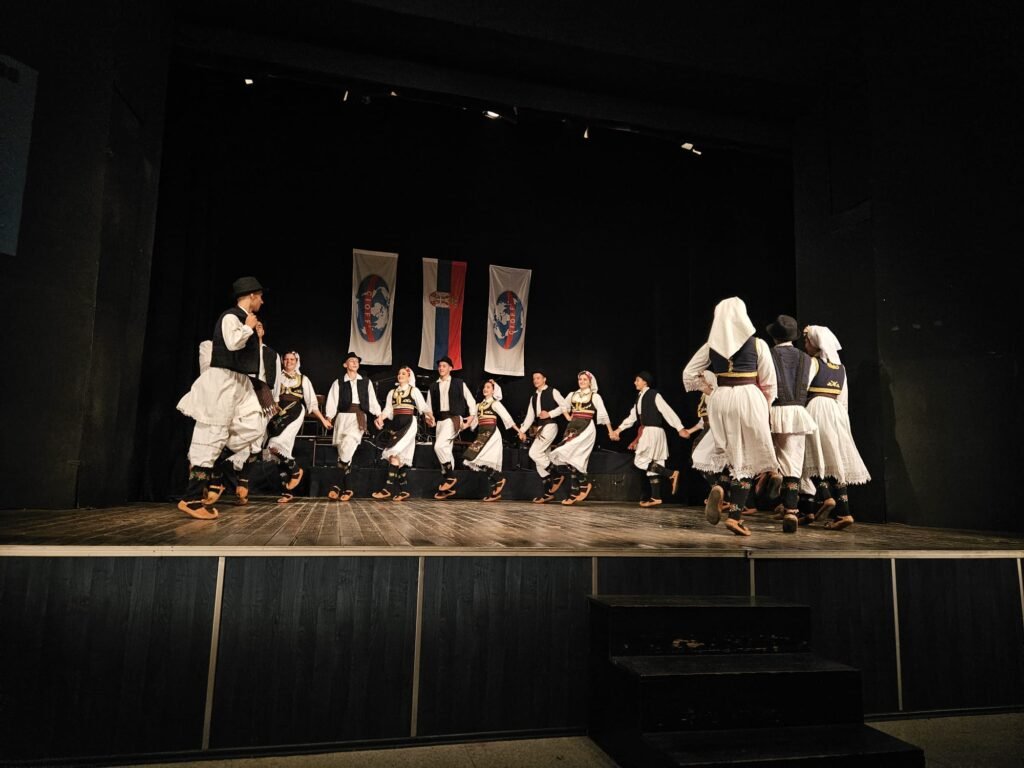
A CIOFF evening celebrating tradition and friendship among nations Prnjavor (Mačva, Serbia), 8 August 2025 — At the Cultural Center in Prnjavor, even if only for one evening, the stage became a crossroads of traditions. Bright costumes, captivating rhythms, and knowing glances—the entire hall pulsed with the same rhythm. About CIOFF CIOFF (International Council of Organizations of Folklore Festivals and Folk Arts) brings together festivals, ensembles, and enthusiasts with the aim of preserving, promoting, and passing on the world’s folk cultures. Its hallmark is the encounter on stage, rooted in respect for identity and a desire for sharing. A hall that gathers people together The performance took place in a hall, on a stage, in a setup close to theater: clear entrances and exits, precise lighting design, and transitions rehearsed down to the smallest detail. The overall impression? A demanding presentation that highlights both the performers and the folklore, supported by smooth, well-coordinated organization. Djenka, ceremony host A special tribute to Djenka, the host and true running thread of the evening. He changed outfits—sometimes in the colors of Serbia, sometimes as a subtle gesture of respect to the invited countries—showing a strong sense of rhythm and understated humor. He introduced each ensemble, showed respect for the performers, and effortlessly drew the audience in. With every appearance, the right word; with every finale, a shared smile. The Ensembles: Highlights and Impressions Argentina — The Pulse of Sharing A warm, almost family-like energy. You can feel generations calling out to one another, movement being inherited and reimagined anew. The sound of footsteps calls out, and the hall responds: a virtuous circle that leaves a lasting smile on the face. Russia — Sleek Lines, Held Breath Burning youth, upright posture, precise lines. Lifts and jumps brush against the virtuosity of artistic gymnastics, without ever losing the musicality of folklore. A few moments seem frozen in the air, followed by sincere applause. Cyprus — The Art of Balance Here, elegance is hidden in detail: carefully handled props, measured entrances, and subdued exits. A choreography in which every pause carries weight, where the collective matters more than display. One island, one soul. France (Brittany) — Briny Wind Packed circles, joined hands, an insistent rhythm: Brittany explains nothing, it draws you in. One finds oneself following the beat, as if captured by some inner dance. Republika Srpska — Pride and Precision Impeccable lines, precise accents, flawless posture. That blend of discipline and joy that gives large ensembles their brilliance: unison as a promise, costume as celebration. Serbia — Home, Roots When Serbian ensembles enter, the hall changes. The power of the rhythms, the joy of the circles that are formed, the confidence of inherited steps. This is our home, and it is open to everyone: Serbian hospitality, expressed through music and movement. A moment of tribute The highlight of the evening: each ensemble took one Serbian motif and blended it with its own choreographic language. A variation on the kolo as a tribute to the host country: respect for tradition, freedom of interpretation. Unity in diversity—the CIOFF spirit in action. Why it matters to FYSE For the Federation of Young Serbs of Europe, this evening is a bridge: between the youth of Europe, between family memories and today’s stage, between the Serbia we carry within us and the curiosity we are proud of. Tradition is not a museum—it breathes when it is danced, and it is passed on when we invite someone to join the kolo. Thank you Thank you to CIOFF for the invitation and the trust. Thank you to the Cultural Center in Prnjavor for its attentive hospitality. Thank you to the ensembles for their generosity. And above all, thank you to Djenka: your art of presenting, connecting, and paying tribute to both artists and audience gave rhythm to the entire evening.

Scroll to Top