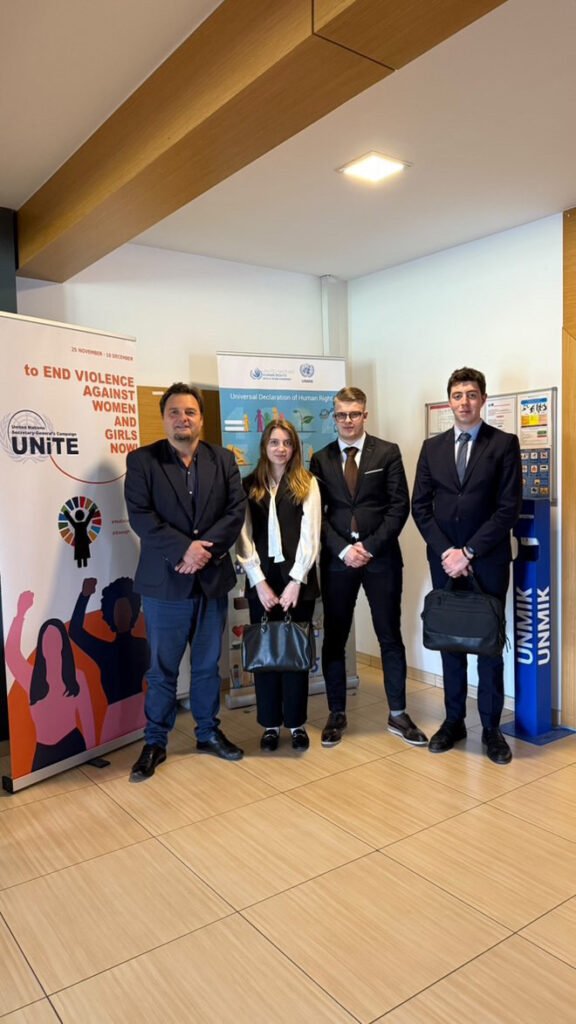
From Renan to Kosovo: a reflection on what unites us Carried by the wave of Europe’s migration-shaped electoral politics, the question of identity has imposed itself across all political debates in Europe. This concept, often used imprecisely, provokes significant controversy, as it has never been clearly defined. During the First Congress of Serbian Youth, organized in Vienna on 7 June 2025, while discussions among participants had only just begun with the aim of defining a strategy for the development of Serbian diaspora organizations, the debate quickly shifted toward a reflection on what it actually means to be Serbian. Very different ideas immediately emerged, revealing how difficult it is to define identity. This shift in the discussion toward a question that is at once broad and unresolved highlights a deeper issue: can collective identity still be clearly and commonly defined? And if not, what is the point of speaking about it at all? Identity remains an unresolved question. Yet, as with “woke” ideology, its use in public discourse was supposed to ensure a clear definition. One might therefore assume that the very lack of consensus around the definition of identity explains the differences in how people understand what it means to belong to a nation. The truth is that agreement on such a definition is impossible: the Congress itself could not resolve a debate that has lasted for centuries. Identity is defined as “the character of that which, under different names or forms, constitutes one and the same reality,” according to CNRTL. It is therefore closely linked to the concept of the nation, which is also at the heart of political debate. In this sense, it might be more precise to speak of national identity in order to avoid confusion with individual identity. The question of the nation has long been central to profound philosophical reflections, which help us understand that the debate held at the Vienna Congress, although legitimate, is ultimately infinite in scope. And what is infinite is abstract and beyond our rational grasp: the debate therefore appears futile and unnecessary. The very idea of the nation has divided European societies, sometimes even neighbouring ones. Thus, after the fall of Prussia under Napoleon’s control of the territory, Fichte (Reden an die deutsche Nation, 1808) called for a spiritual and moral renewal of the German people by awakening their national consciousness. For him, the nation refers to a community of language and culture, rather than a legal or political construct. It precedes the state, which exists only to serve it. The people are united by language, education, and culture. Later, Renan developed the “French vision” of the nation in his famous lecture at the Sorbonne in 1882. At a time when nationalism was rising in France following the defeat by Prussia, Renan sought to define the nation from a republican and rational perspective, in opposition to certain identitarian deviations. He argues that the nation is a historical and political construction based on the will to live together. The nation, therefore, is neither race nor language (which may bring people together but does not impose obligation), and even less religion or geographic boundaries. It is characterized by a shared past, through collective memory marked by common suffering and shared glory, as well as by a present-day desire to continue this shared history: what he calls a “daily plebiscite.” This French vision has long existed. The principle of jus soli (right of the soil) has its customary origin in a ruling of 23 February 1515 by the Paris Parliament: a child born to foreign parents was considered a subject of the king, and thus French. After the Revolution, the Napoleonic Code allowed children of foreigners born in France to claim citizenship upon reaching adulthood. In 1889, the Third Republic automatically granted French citizenship to every child of foreign parents born in France, unless they chose to refuse it. This principle is today the subject of numerous criticisms (notably in Mayotte) and has been modified several times. It seems clear today that the French philosophical approach has been confirmed by reality. If some find it difficult to accept, the proof was given during the Congress in Vienna: language or religion can no longer define a nation. Without delving into the fact that many people know the French language and history without feeling French at all, the example of Kosovo is more than sufficient. After the Second World War, Marshal Tito decided to accept Albanian refugees and to marginalise Serbs from that territory, which is nevertheless central to their history, since the Battle of Kosovo (1389) where they managed, despite all circumstances, to repel the Ottomans. Albanians attended Serbian schools, learned their language and history, and benefited from a Yugoslavia that offered them more than they would have had in Albania. One might therefore assume that, after one or two generations, they would become Serbs, at least out of gratitude. Yet, despite everything, they did not hesitate to form an armed organisation that some states labelled as terrorist (the KLA) in order to achieve independence, in violation of international law but with NATO military support. If the West made a strategic mistake here (and itself receives large numbers of migrants, while Russia today uses this tragic violation of international law to justify its “military operation” in Ukraine), the fact remains that a nation is not a matter of language, culture, or religion, but of feeling. It therefore seems clear that, in relation to this issue so important for Serbs, the debate perhaps should not have taken place at all. There is also the question of Serbs whose ancestors emigrated to other countries and who have lost their connection to the homeland. Is it less legitimate to consider them Serbs? Simply because they do not speak the language or are only learning it? And what about those who have fallen in love with Serbia and wish to become Serbian? The question remains without a definitive answer. Yet it seems to me that this debate,